Puffins on the Cliffs of Moher
Puffins dig into the grassy slopes, while razorbills and guillemots take the narrow ledges. The cliffs hold several kinds of nesting place, and a colony gathers below.
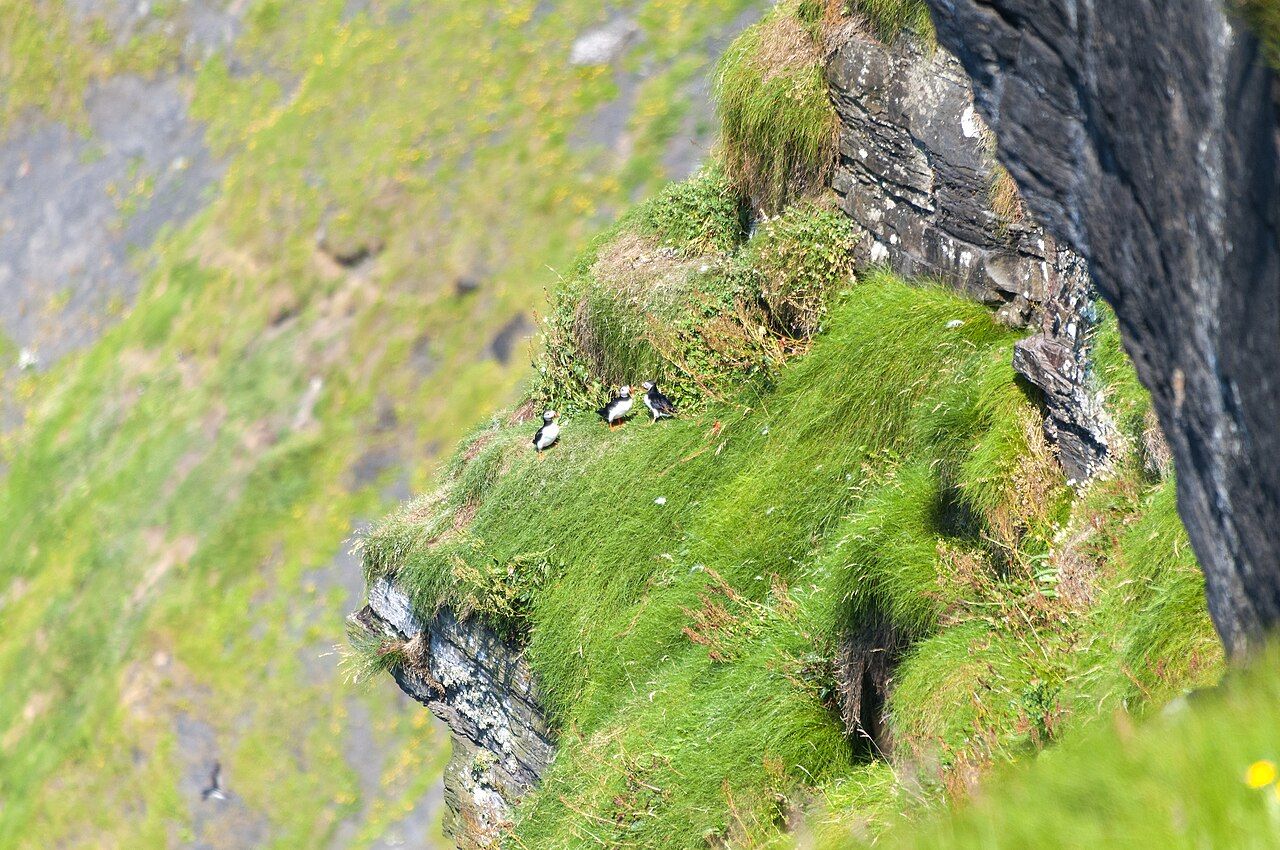
What makes a cliff a seabird colony? At the Cliffs of Moher, the answer is not one nesting place but several. Puffins dig burrows in the soil on the cliff tops and steep slopes. Razorbills and guillemots nest on the narrow rock ledges. Kittiwakes and fulmars also nest on the cliffs. Below them, Branaunmore, a sea stack, holds a dense seabird colony. A great deal is packed into those differences of ground and rock.
Puffins arrive in late March or April and leave by early August. That gives the season a clear shape, though the useful detail is not only the dates. It is where the birds nest. Especially on Goat Island and the steep grassy slopes, the puffins are burrowers. The soil is part of their nesting place, not merely the ground beneath it. A cliff can look like a single face from a distance; the nests make its separate surfaces matter.
The contrast is simple: soil above, narrow ledges below, and a sea stack beneath the cliffs.
The contrast is simple: soil above, narrow ledges below, and a sea stack beneath the cliffs.
That division gives the colonies a little order. Puffins use burrows dug into soil on the cliff tops and steep slopes. Razorbills and guillemots use narrow ledges. Kittiwakes and fulmars are part of the cliff nesting too, though the facts do not set out their particular nesting places. It is better to leave that distinction open than to make every bird fit the same picture. The cliffs are shared, but the nesting arrangements are not all alike.
That is why a seabird colony is not a single sort of crowd. The puffin burrow starts in soil, on the cliff tops and steep slopes; the razorbill and guillemot nesting place is a narrow ledge. The kittiwakes and fulmars belong to the same cliffs, while Branaunmore holds a dense colony below. No one detail cancels the others. The scene is made by these different places, close in the larger account but not interchangeable. The puffin season gives one clear timetable; the other birds are not assigned dates here.
See also The Flaggy Shore and a poem.
Goat Island is especially associated with the puffins, along with the steep grassy slopes. The word “especially” matters. It points to places worth holding in mind without turning the whole cliff into a puffin burrow. There are other birds here, other kinds of nesting ground, and the larger colony at Branaunmore below. A plain account of the place is more useful than a single emblem pressed into service for every ledge and slope.
Branaunmore adds another scale to the story. It is a sea stack below the cliffs, and it holds a dense seabird colony. The description is brief, but it changes the picture: the cliff colony is not only a line of nests along the face, nor only burrows in the grassy ground above. There is also a colony gathered on the stack beneath. The word “dense” does its work without needing decoration.
A separate thread of the coast sits in Currachs and the island sea, while this account stays with the nesting birds of the cliffs. That boundary helps keep the subject clear. Here, the main story is the combination of burrows, ledges and the sea stack, with puffins present for a defined part of the year. The other named birds belong in the same account, but they do not need to be given the puffins’ dates. Those dates are specific to the puffins.
For visitors, the practical point is straightforward: the puffins are not here all year. They arrive in late March or April and leave by early August. Within that span, Goat Island and the steep grassy slopes are the places singled out for them. The ledges belong to razorbills and guillemots in the nesting account, and the cliffs also hold kittiwakes and fulmars. Branaunmore, below, has its dense seabird colony. More than that would be guesswork, and there is no need for it.
The Cliffs of Moher make a fine subject because the details stay distinct. Burrows in soil. Narrow rock ledges. A sea stack below the cliffs. Several kinds of seabird nesting, with puffins arriving in late March or April and leaving by early August. The place needs no grander claim than that. Even the puffins have a short lease.
The numbers: late March or April to early August. Even the puffins have a short lease.