Kilfenora’s Crosses and Cathedral
On the southern edge of the Burren, Kilfenora brings a small cathedral, carved high crosses and a long musical identity into a compact village story.
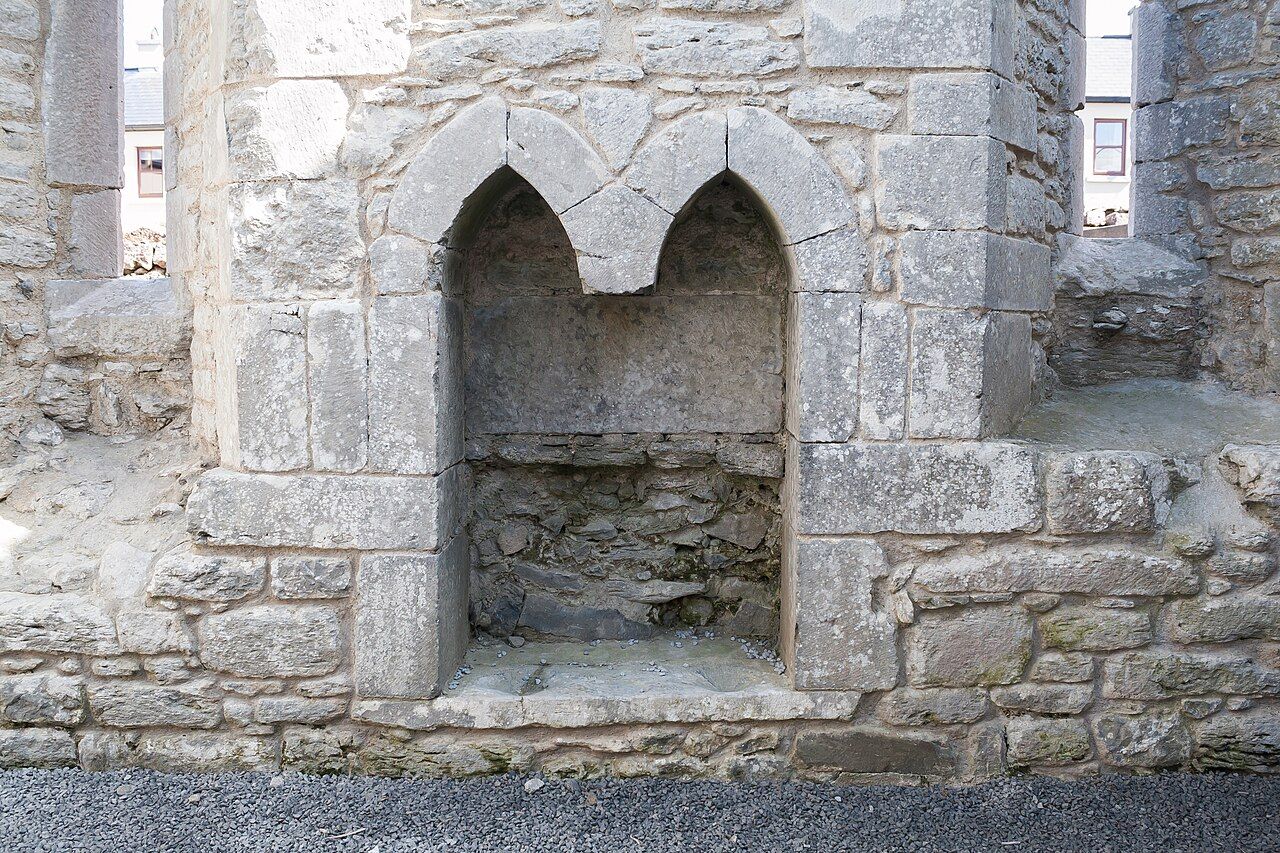
Kilfenora sits on the southern edge of the Burren, a village with a small cathedral at its centre of attention. St Fachtnan’s gives the place its particular scale: not a grand cathedral town, but a small village with a cathedral and several carved high crosses standing there. The facts are few, and the stones do most of the speaking. They make a visit less a matter of covering ground than of looking properly at what has been set in it.
Several high crosses stand at the cathedral, dating from the twelfth century. That date gives them a place in time, but the first encounter is with their carved surfaces and forms. A cross can be read at a glance as a shape; the carving asks for another look. Details that might be passed over when the whole is taken in at once become the reason to pause. The effect is not grand drama. It is attention, offered in small measures, and a useful correction to the urge to hurry from one named thing to the next.
The Doorty Cross gives that attention a subject to follow. It shows a bishop and other carved figures. The figures make the cross more than an outline: there are people to look at, and the eye can move between them without needing a complete explanation of every mark. It is enough to notice how the image is arranged and to take in the difference between seeing a cross from a little distance and studying its carved details. No invented story is needed to make the stone hold interest.
The crosses do not need a grand setting to hold the eye. Their place at the cathedral is the point: the village’s religious history is not separated from the carved work, nor does it need a long introduction before the stones can be looked at. Kilfenora’s diocese is one of the smallest in Ireland. That scale sits naturally beside the small cathedral, though size alone does not explain the crosses. The pleasure lies in the contrast between a modest place and work that rewards close attention, without turning the contrast into a claim that the village is something other than it is.
The crosses do not need a grand setting to hold the eye.
Part of the cathedral’s chancel has been covered with a glass roof to protect its carvings. It is a practical fact, and also a reminder that carved stone needs care if its details are to remain. The roof belongs to the present encounter with the cathedral: not an ornament added to make a story, but a measure taken for the carvings. That gives the chancel a different emphasis from the crosses outside it. Protection becomes part of how the place is understood, alongside the work the roof is there to protect.
It would be easy to treat the crosses as the whole of Kilfenora. They are the clearest reason to stop and look, but the village also has a musical identity. Kilfenora is the home of the Kilfenora Céilí Band. That fact gives the place another kind of presence, one carried by music rather than by carved stone. The two belong in the same account without being made to explain one another: the crosses are here at the cathedral, and the band is part of the village’s name and character.
See also Ennistymon and the Cascades.
For visitors, the useful approach is a simple one. Let the cathedral and its crosses remain the subject, rather than expecting a long list of sights from a small village. Look at the several crosses as individual pieces, then give the Doorty Cross time for its bishop and other figures. Notice the glass roof over part of the chancel, and what it says about the care of the carvings. Its interest comes from the things actually here, and from the way a small collection of details can hold attention.
Kilfenora makes a quiet case for looking closely. The cathedral is small; the diocese is one of Ireland’s smallest; the crosses belong to the twelfth century. These are plain facts, but they do not reduce the place to a set of measurements. Stone holds the carved figures, a roof protects carvings in the chancel, and a céilí band is part of the village’s identity. Nothing needs inflating. Kilfenora is best met at its own scale, with enough time for the eye to move from the whole cross to the figures on it, and back again.
The numbers: the diocese is one of Ireland’s smallest; the crosses date from the twelfth century.